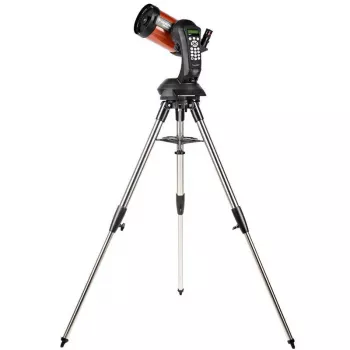
A computerized telescope can make your first nights under the stars more approachable, especially when you want help finding objects beyond the Moon. The 125mm f/10 Schmidt-Cassegrain GoTo telescope combines a compact optical tube with a long focal length and StarBright XLT coatings. It still takes a little preparation, but a thoughtful setup can help you spend more time observing and less time searching. For more guidance, see Celestron NexStar 8SE Review: Yes, It’s Worth It! Here’s Why..
The aperture is the diameter of the telescope’s main light-gathering surface. At 125mm, this telescope gathers substantially more light than your unaided eye, helping you see brighter celestial objects and some fainter targets. Aperture also influences the detail a telescope can resolve, although the atmosphere and other conditions often limit what you can see on a given night. For further reading, see Best Computerized Telescope (Our Top 10 Picks for 2021).
The f/10 focal ratio means the focal length is ten times the aperture: 1,250mm. That relatively long focal length can be useful when observing the Moon and planets at higher magnifications. Your actual magnification depends on the eyepiece you use: divide 1,250mm by the eyepiece’s focal length in millimeters.
A Schmidt-Cassegrain design folds the light path inside the tube, providing that long focal length without a tube of the same physical length. StarBright XLT is an optical coating system designed to improve light transmission through the telescope.
| Feature | Specification | What It Means |
|---|---|---|
| Aperture | 125mm | Determines the telescope’s light-gathering capability |
| Focal ratio | f/10 | Pairs with the aperture to give a 1,250mm focal length |
| Optical design | Schmidt-Cassegrain | A compact design with a long focal length |
| Pointing | Computerized GoTo | Assists with locating objects after alignment |
| Coatings | StarBright XLT | Designed to improve light transmission |
For more background on how telescopes gather and focus light, see NASA’s guide to telescopes.
The Moon is an inviting first target. Its craters, mountains, and shadowed edges are easy to find, and their appearance changes throughout the lunar cycle. Try observing along the boundary between light and darkness, where shadows can make surface features stand out.
Bright planets are also rewarding when they are visible. Jupiter may show its prominent cloud bands and nearby moons, while Saturn’s rings can be recognizable. The amount of detail you see depends on atmospheric steadiness, the planet’s position, and the magnification you choose. More magnification does not always mean a clearer image; if the view looks soft or shaky, try a lower-power eyepiece.
Bright star clusters and some nebulae and galaxies offer another kind of observing. Many faint objects benefit from a dark sky and time for your eyes to adjust. Even then, visual views generally do not resemble the colorful, detailed images made with long photographic exposures. Some objects may appear as delicate patches of light rather than clearly defined shapes.
Local light pollution can wash out those faint views. DarkSky International’s light pollution guide explains why darker observing locations make a difference.
GoTo pointing is a helpful aid, not a substitute for initial setup. The computerized system generally needs to be aligned before it can locate objects accurately. Follow the supplied instructions for the alignment procedure, including any required location, date, or time information.
Choose an open spot with a stable surface and a clear view of the sky. Trees, buildings, and nearby lights can limit your choices, while observing over rooftops may introduce heat-related image distortion. Give the optics time to adjust to the outdoor temperature before judging the sharpness of the view.
Begin with a bright object you can identify confidently. Once you are comfortable centering targets and using the controls, move on to a bright cluster or another less obvious object. A lower-power eyepiece can make it easier to find and center a target before you increase magnification.
Plan for your own comfort, too. Outdoor sessions can last longer than expected, so dress for the temperature and bring a layer. If you are preparing for a cool evening, our Dr. Martens Women’s Black Leather Boots are another item to consider alongside your observing gear.
This telescope is worth considering if you value computerized help finding objects and want a long focal length in a compact optical design. It can be a good match for lunar and planetary observing while still giving you access to brighter deep-sky targets.
Before buying, think about where you will store and use the complete setup, how far you will need to carry it, and whether your usual observing location has an open view. Also consider your preferred targets: a long focal length is useful for magnifying small objects, but very large areas of sky may be harder to fit into one view.
Our team recommends giving yourself time to learn the alignment process and explore at a comfortable pace. Visit our 125mm F10 Schmidt-Cassegrain Computerized GoTo Telescope with StarBright XLT product page for current purchasing details.
Yes. Computerized pointing generally requires alignment before the telescope can locate targets. Follow the supplied instructions for the specific procedure.
Yes. You can observe the Moon, bright planets, and brighter deep-sky objects such as star clusters. Visible detail depends on sky conditions, the target, and magnification.
It means the focal length is ten times the aperture. For a 125mm aperture, that gives an implied focal length of 1,250mm.





Leave a comment