Montessori Arithmetic Board: Wooden Math Play at Home
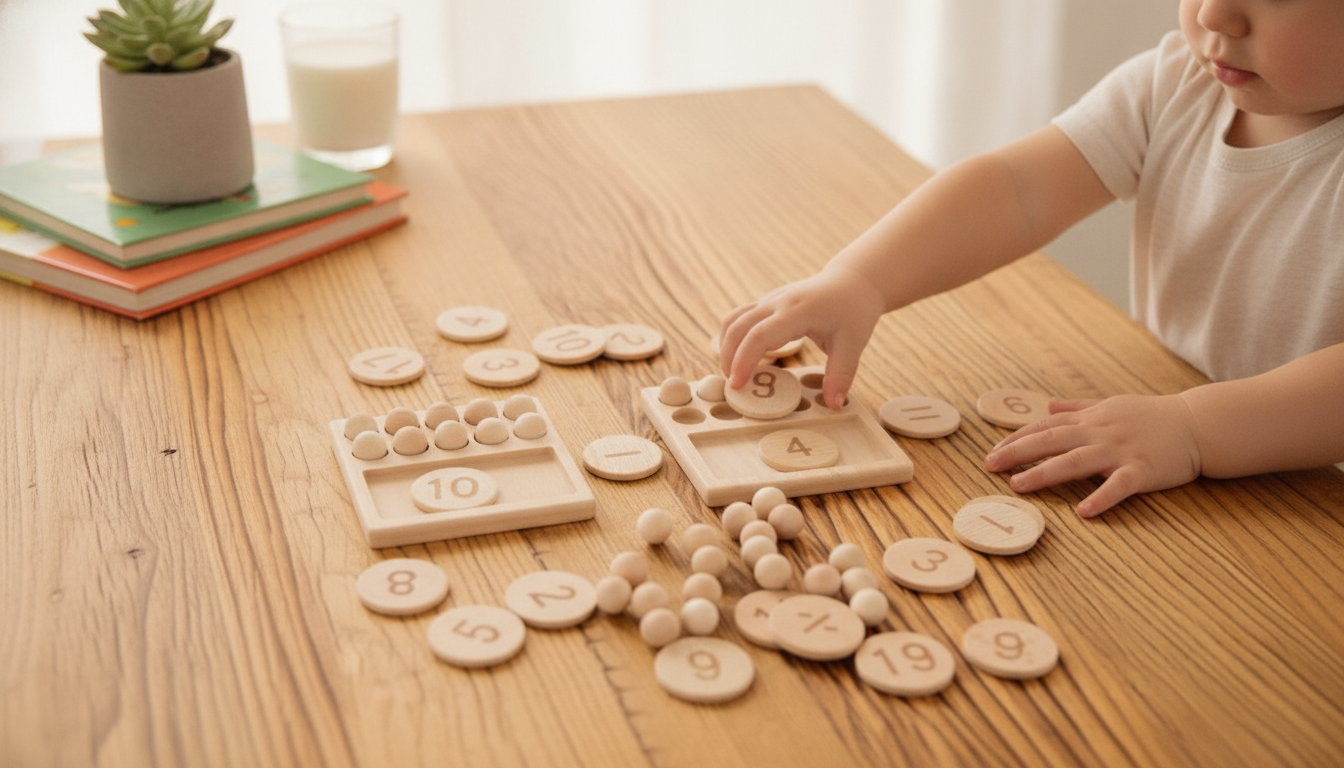
Montessori Wooden Arithmetic Board: Hands-On Number Skills Through Play
A wooden arithmetic board turns early math into something children can touch, move, and explore. With numbers and operation pieces that can be rearranged again and again, it supports counting, simple equations, and problem-solving in a calm, screen-free way. The goal isn’t rushing to “get answers,” but helping kids build a steady sense of how numbers work—one tile at a time.
What an arithmetic board is and what it helps children practice
An arithmetic board is a reusable, tactile learning tool that lets children build number sequences and math sentences using physical pieces (often tiles, rods, or symbol blocks). Because the parts can be placed, removed, and rearranged, children can repeat skills without the pressure of permanence that comes with worksheets.
- Introduces number recognition and counting with physical pieces that can be placed and removed.
- Builds early operation awareness by arranging simple addition, subtraction, multiplication, or division sentences (depending on the set).
- Strengthens fine-motor control and hand–eye coordination while children handle tiles and symbols.
- Encourages self-correction: children can see when an equation looks “balanced” or when a piece is missing.
- Supports independent work or guided practice with a parent, caregiver, or teacher.
This kind of “do it with your hands” practice can be especially helpful for children who learn best through movement and concrete examples before they’re ready for abstract pencil-and-paper math.
Why wooden, tactile materials work well for early math
Early math skills grow fastest when children can connect quantities to symbols in a way that feels real. Wooden materials naturally encourage a slower pace and more focused engagement, which can be a refreshing contrast to fast, animated digital practice. For families aiming for balanced media habits, the American Academy of Pediatrics offers practical guidance on children and screen time here: https://www.aap.org/en/patient-care/media-and-children/.
- Concrete learning: manipulating objects helps connect quantities to symbols, especially for beginners.
- Slower, focused play: wood materials typically reduce distractions and promote longer attention spans.
- Multi-sensory reinforcement: seeing, touching, and placing pieces can improve recall of number facts.
- Routine-friendly: boards can be used for quick daily drills or longer open-ended exploration.
- Durability: wooden parts usually tolerate repeated use better than thin paper flashcards.
Montessori-aligned environments emphasize hands-on, self-directed learning; the Association Montessori Internationale provides an overview of Montessori education here: https://montessori-ami.org/.
How to use a Montessori arithmetic board at home
A simple rhythm works best: short sessions, clear steps, and plenty of repetition. Think “practice that ends on a positive note,” not marathon lessons.
- Start with counting: ask the child to place number tiles in order, then mix and rebuild the sequence.
- Match quantity to symbol: place small objects (beans, buttons) next to a number tile to show “how many.”
- Introduce one operation at a time: begin with simple addition facts (like 1+1 or 2+1) before mixing problem types.
- Keep sessions short: 5–10 minutes is often enough for younger children; stop while it’s still enjoyable.
- Use real-life prompts: “You have 3 grapes and get 2 more—can you build that on the board?”
- Encourage self-checking: have the child read the equation out loud and verify the result with counters.
If your child hesitates, treat it as useful information: go back a step (smaller numbers, more counters, fewer pieces on the table) and rebuild confidence through easy wins.
Skill progression ideas (from beginner to more advanced)
Progress tends to look like a gentle shift from concrete to abstract. The board stays the same, but the child needs fewer supports over time.
Sample activities by age and readiness
| Age/Readiness | Activity | Goal | Quick tip |
|---|---|---|---|
| 3–4 (beginner) | Place numbers in order; find the missing number | Number recognition and sequence | Use only 1–10 at first |
| 4–5 (ready for operations) | Build addition facts with counters then tiles | Connect quantity to symbols | Celebrate correct process, not speed |
| 5–6 (more confident) | Subtraction and fact families (e.g., 5=2+3) | Flexible thinking about numbers | Ask the child to explain each step |
| 6+ (early mastery) | Create mixed problems and solve without counters | Fluency and reasoning | Rotate challenge levels to avoid frustration |
What to look for when choosing a wooden arithmetic board
Montessori Wooden Arithmetic Board (available now)
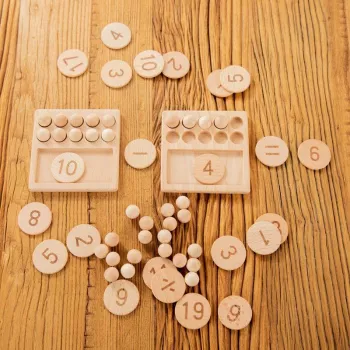
For families who want a reusable, screen-free way to practice numbers and simple operations, the Montessori Wooden Arithmetic Board is designed for hands-on learning and repeated practice. It fits well into independent play, homeschool routines, or teacher-led stations, and it pairs naturally with small counters (buttons or beads) to show quantities before transitioning to tiles only. Product details and current price are available on the product page.
More in-stock favorites
- Elevated Ceramic Pet Bowl with Solid Wood Stand (a sturdy wood-and-ceramic home essential)
FAQ
What age is a Montessori arithmetic board best for?
Many children use an arithmetic board from preschool through early elementary (roughly ages 3–7), but readiness matters more than age. If small parts are included, adult supervision is important for younger children.
How can a child use an arithmetic board without getting frustrated?
Start with small numbers and one operation at a time, and use counters as a “bridge” to understanding. Keep practice short (often 5–10 minutes) and focus praise on effort and clear steps rather than speed.
Does an arithmetic board help with addition and subtraction fact fluency?
Yes—consistent hands-on practice helps children understand what addition and subtraction mean before they try to memorize facts. Over time, many children naturally move from counters to tiles only, which supports both accuracy and faster recall.














Leave a comment