
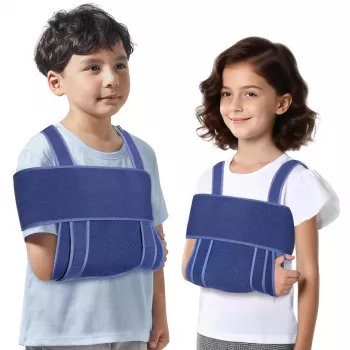
For many shoulder fractures, a well-fitted arm sling that supports the forearm and keeps the arm close to the body is appropriate. Some fractures require a shoulder immobilizer, which adds a strap around the torso to limit shoulder movement. The best choice depends on the location and severity of the fracture, so use the type recommended by your clinician.
A sling can make the arm more comfortable and help protect the injured area, but it is not a substitute for an examination. If you suspect a new fracture, seek prompt medical care rather than choosing a sling as your only treatment.
A standard sling has a fabric pouch or support that holds the forearm, with a strap over the shoulder or around the neck. It may be suitable when your clinician wants the arm supported but does not require it to be secured tightly against your body.
A shoulder immobilizer usually combines a sling with a band that holds the upper arm closer to the torso. Your clinician may recommend one when the shoulder needs more restriction, including after certain fractures or procedures. Do not add a tightly wrapped band yourself unless you have been instructed to do so.
We recommend looking for an adjustable sling that supports the arm from the elbow through the wrist. Your elbow should sit securely in the back of the pouch, and your hand should not hang over its edge. Adjust the strap so your forearm rests comfortably across your body, following any position your clinician has prescribed.
The sling should feel secure without pressing painfully into your neck or causing tingling. Keep your fingers visible so you can notice swelling or changes in color. For more on adjustable support, see our guide to arm sling fit and comfort.
Contact your care team if the sling cannot support your arm comfortably or if pain or swelling worsens. Seek urgent medical attention if your hand becomes cold, pale or blue, or if you develop new numbness or weakness. Our team recommends following your clinician’s instructions about when to remove the sling and whether to move your elbow, wrist or fingers.
You can usually adjust the strap for comfort while keeping your arm in the position your clinician prescribed. Ask your care team for help if you cannot achieve a secure fit or if adjusting it increases pain.






Leave a comment